
Signalling is the nervous system of a railway. The signals, point machines, axle counters, track circuits and interlocking systems that keep trains separated and moving safely are connected by miles of cabling and thousands of connectors installed in environments ranging from sealed relay rooms to outdoor trackside locations exposed to every extreme of the Indian climate. When a signalling connector fails, the consequence is not merely an inconvenience — it is a potential disruption to train operations, and in the most serious cases, a safety event. The reliability requirements that follow from this context are among the most demanding in the connector industry.
The Signalling Environment: More Demanding Than It Appears
Trackside signalling equipment operates without the climate control that protects equipment in buildings. A signal head or point machine at a remote rural location may experience temperatures ranging from well below zero in winter to over fifty degrees Celsius in direct summer sunlight. Monsoon rain, flooding and the continuous vibration of passing trains apply mechanical and environmental stresses that slowly degrade inadequately specified interconnects. High voltage traction currents in electrified territory induce electromagnetic interference that corrupts signals from connectors whose shielding is incomplete or incorrectly terminated.
In relay rooms and interlocking buildings, the environment is more controlled but the connector density is very high. Dozens of identical connectors on adjacent equipment create a persistent risk of mis-mating during maintenance, which is why polarisation and clear identification are as important in these installations as environmental sealing is in outdoor locations.
Safety Integrity and the SIL Framework
Modern railway signalling systems are designed to Safety Integrity Levels defined in the EN 50126, EN 50128 and EN 50129 standards. While these standards address system-level safety rather than component-level specifications, they create requirements that flow down to every component in the safety function chain, including connectors. A connector used in a safety-critical signal path must have a documented failure mode and failure rate that can be used in the system’s probabilistic safety assessment. This requires a connector manufacturer who can provide not just a datasheet but a documented reliability analysis based on qualification testing and field history.
Trackside Applications and Their Connector Requirements
Signal Heads and Level Crossing Equipment
Signal heads on main line and suburban routes use LED lamp technology that draws modest currents but requires highly stable connections to maintain correct aspect display. Level crossing barrier mechanisms and their associated detection equipment are exposed to vehicle vibration, weather and occasional impact. Both applications require connectors with IP67 or IP68 sealing in mated condition, positive locking coupling to resist vibration-induced loosening, and corrosion-resistant shell materials that maintain their sealing geometry over decades of service.
Axle Counters and Track Circuits
Axle counter systems detect the passage of wheel flanges using trackside sensors connected to evaluation electronics by signal cables. The connector at the trackside sensor is one of the most demanding in the entire installation: it is within centimetres of passing trains, exposed to the full outdoor environment, and expected to maintain microamp-level signal integrity across its working life. These requirements push engineers toward the same circular connector families used in defence applications, where the combination of certified sealing, positive locking and documented reliability data is standard.
Relay Rooms and Interlocking Panels
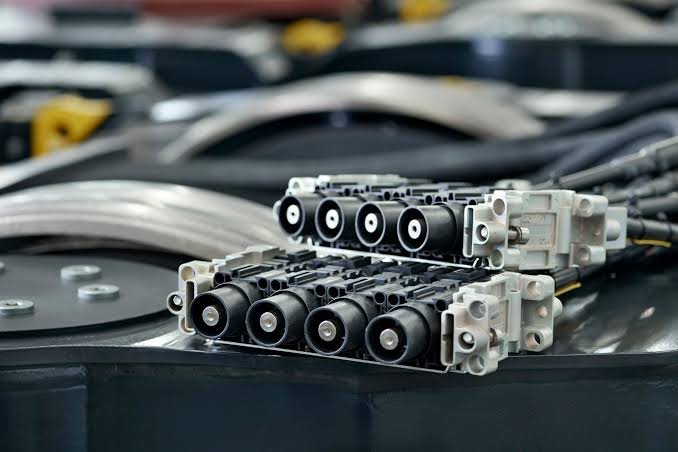
The dense wiring inside interlocking relay rooms is typically managed through cable harness assemblies that bring orderly, pre-tested wiring to each rack position. A pre-built and tested harness arriving at site eliminates the termination errors that are the leading cause of commissioning faults in relay room installations. The railway connectors used in these assemblies must be polarised to prevent mis-mating, must carry clear circuit identification, and must be terminated using calibrated crimp tooling with records that satisfy the railway’s quality audit requirements.
RDSO Approval and Indian Railway Standards
India’s Research Design and Standards Organisation sets the technical standards for railway equipment used on Indian Railways’ network, and connector manufacturers who wish to supply these systems must be approved by RDSO for the relevant product categories. The RDSO approval process includes laboratory testing of product samples and an audit of the manufacturer’s quality management system, providing a level of assurance that self-certification cannot replicate. Specifiers working on Indian Railways programmes should verify that proposed connector suppliers hold current RDSO approval for the specific product family required, and should request copies of the approval certificate as part of the vendor qualification process.
For signal cable termination applications where standard catalogue connectors do not provide the right insert arrangement, working with a manufacturer to develop a qualified variant is preferable to adapting an off-the-shelf product. Qualified MS connectors can be configured with non-standard insert arrangements through the manufacturer’s customisation process while retaining their RDSO approval status, provided the customisation is documented and the resulting product is tested to the relevant specification.
Selecting the Right Supplier
Railway signalling procurement benefits from the same discipline applied to defence procurement: approved vendor lists, qualification evidence and lifecycle support commitments matter more than initial unit price. Established qualified connector manufacturers in India holding RDSO approvals and with a track record of supplying signalling applications provide the accountability and supply continuity that this safety-critical segment demands. Allied Electronics Corporation has supplied Indian Railways as an approved source and understands the documentation and quality system requirements that railway projects impose.
Conclusion
Railway signalling connectors operate at the intersection of electrical performance, environmental durability and functional safety, and the consequences of failure justify the care taken in their specification and procurement. Verify RDSO approval status, specify to published standards, insist on polarisation in dense installations and procure from a supplier who can provide reliability data and lifetime support. These are the disciplines that keep signalling systems working long after the installation team has moved on to the next project.